Leslie Newson joined London Transport in 1969 and by the time of our story, he'd developed a reputation among his colleagues for being a skilled and careful train driver.
On February 28th, the 56-year-old Newson left for work with his usual supplies: a rule book and a notebook to record details of any train defects or issues he might encounter, milk and sugar for his tea, and $270 in cash which he planned to use after his shift to buy his daughter a second-hand car.
His behaviour that morning was reported to be normal, with Newson his usual, friendly self, and he started his work day with a cup of tea and a chat with a work colleague before heading off for his shift, which began at 6:40am with a departure from Moorgate to Drayton Park.
18-year-old Robert Harris was scheduled to be aboard the train that day, having recently joined London Transport as a guard. That morning, however, Harris was running late, so another driver took his place while waiting for his own shift to start.
When the train returned to Moorgate at 6:53, Harris took over and the train headed out on its second journey. The first four trips of the day passed without incident, but the fifth trip would go down in history.
The train departed from Drayton Park thirty seconds late, leaving at 8:38. As nine o'clock approached, the morning rush was in full swing and the train was packed with 300 passengers on their Friday commute.
Frequent riders of the London Underground or, indeed, any busy metro system, will quickly learn the most efficient way to travel and proximity to the exit on Moorgate's platform 9 meant that commuters often favoured the front of the train, and that fateful Friday was no exception. The train was made up of two six-carriage units and most riders had boarded in the front two carriages.
The route's final station before its terminus was Old Street, from which the final leg of the journey was a mere 56 seconds to Moorgate. Newson departed Old Street at 8:45 for the final stretch of the line.
Robert Harris was stationed, as always, by the guard's control panel, which included controls for the emergency brake. But as the train hurtled through its final minute, Harris left the control panel in search of a newspaper to read.
Just seconds later, at 8:46, the train arrived at Moorgate and failed to slow, racing past platform 9 at up to 40 miles per hour, to the horror of onlookers.
Beyond the platform, the line continued for several yards as part of an overrun tunnel built for accidents just like this. The tunnel was filled with a sand drag designed to slow any trains that might overshoot their stop and prevent them from crashing into the solid wall at the end of the tunnel.
Unfortunately, this failsafe was designed for errors during stops, such as a train running at too high a speed when its brake are engaged, or a train that brakes too late and needs additional space to slow down. What it wasn't designed for was a train hurtling through at full speed with no attempt to brake at all.
The sand drag was not enough to slow the train to safe speeds, and the overrun tunnel not long enough to prevent catastrophe. The train ploughed at speed into the solid wall at the end of the tunnel, ending or changing hundreds of lives in a fraction of a second.
Before we discuss the aftermath of this tragic event, let's back up and talk for a moment about the London Underground.
The London Underground, which you'll often hear called simply the Tube, is the oldest underground railway in the world, with its origins traced back to the Metropolitan railway opened in 1863.
These early lines were constructed in the simplest manner possible—deep trenches were dug out from ground level, the lines placed, the tunnels constructed, and the trench filled in and built over, a method known as cut and cover which led to shallow lines running just below the surface, often following the path of roads above in order to avoid unnecessary demolition of buildings to clear the way for the railways beneath.
This method would quickly prove to be insufficient as it prevented any significant infrastructure from being built right in the heart of London where demand was highest, so rail companies began looking into alternatives.
In 1890, the first deep-level railway line was constructed. This method used a boring machine that could worm its way through the city, deep below the surface, allowing construction of lines that could follow any route without causing disruption on the surface. This would prove to be a huge success and many deep-level lines followed.
Today, the network consists of a mix of cut and cover lines, which use large trains similar in size to standard rolling stock you'll find on mainline services all over the country, and deep-level lines which are limited by the size of the tunnels and use much smaller trains.
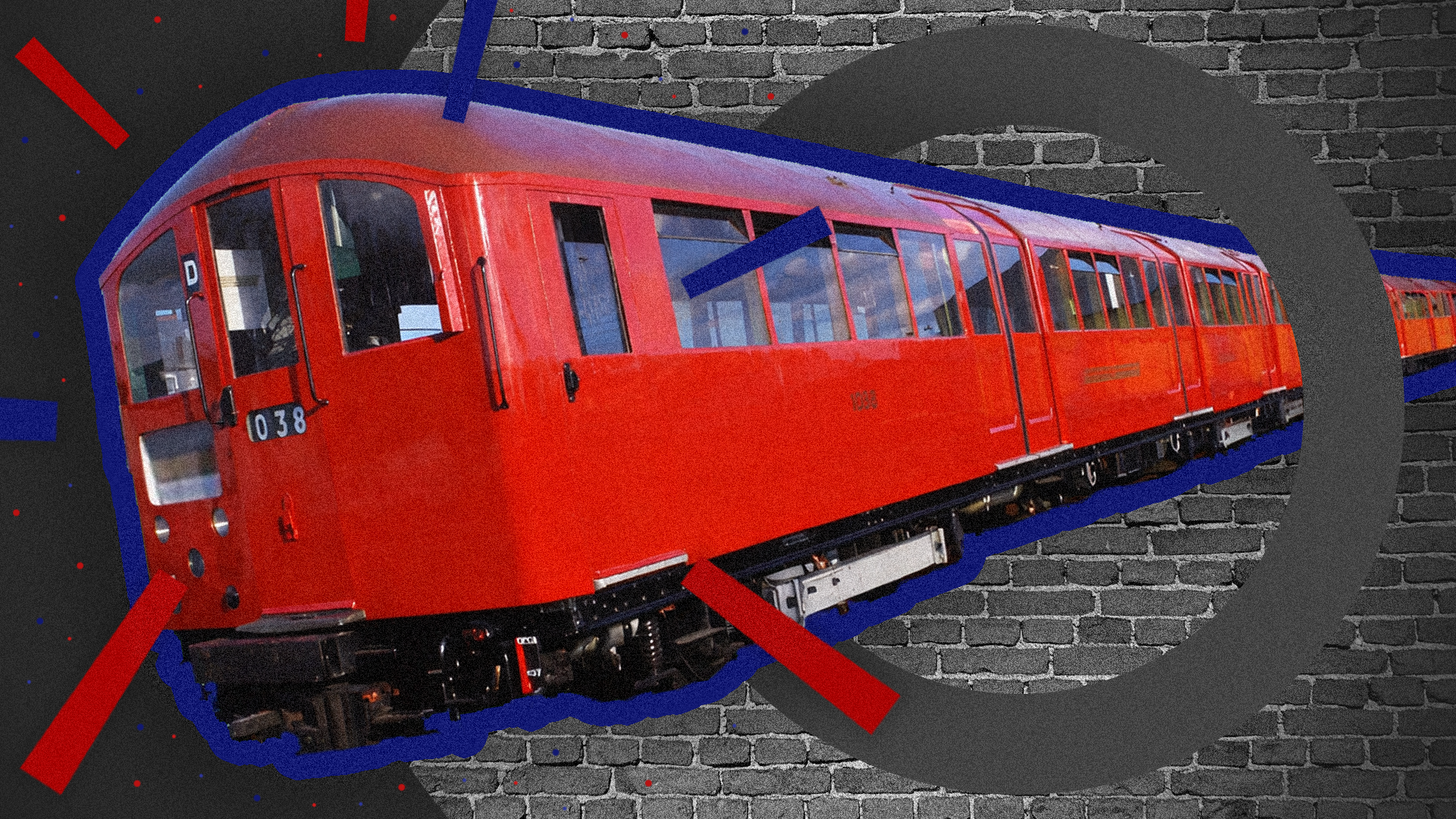
The line our story takes places on, the Northern city Line, is a deep-level line, but uses larger than standard tunnels and is therefore able to carry the larger trains usually found only on the cut and cover lines.
To make matters all the more confusing, the Northern City Line is an underground rail line in London, but it's not actually part of the London Underground—at least, not anymore. There are many rail lines in London, both above and below ground, and while many of them are part of the Underground or Overground networks run by the publicly-owned Transport for London, there are still many run by private rail companies that operate separately to the TfL networks. And over the past century and a half, it's been very common for lines to change ownership and fall under different operators. The Northern City Line is one such example, coming under control of London Transport—TfL's predecessor—from its creation through to October 1975. At the time of our story, the line was still part of the tube network.
While the cut and cover lines generally feel like standard rail lines that just happen to run underground, the deep-level lines are a different beast entirely and I think one of the things most shocking to visitors unfamiliar with the system is just how little space there is. The trains are designed to use up every bit of space and are only marginally smaller than the tunnels themselves, leaving no space for any kind of emergency walkway on the tracks.
Once you're in a tunnel on a deep level tube line, you're in there until you come out the other side. There isn't even an option for an emergency brake like you might find on most trains—the emergency button on a tube train simply connects you to the driver, who will, in almost all circumstances, continue on to the next station, even if an emergency is happening on board.
This might sound wild, but really, it makes sense. The tube network is so dense that, at least in central London, you're never more than a couple of minutes from the next station, often you're waiting just 30-seconds or so. There's just no reason to make an emergency stop when emergency services can be ready and waiting at the next station in just a couple of minutes' time.
All of this to say, the Underground can be a claustrophobic place with very little wiggle room and this would prove to be catastrophic on that awful day in 1975.
While the Northern City Line was built to run larger mainline trains, it was still a deep-level tube line constructed with very little space. The trains were almost as big as the tunnels they drove through, with just a narrow band of space between them and the brickwork.
So when the train drove full-speed into the overrun tunnel at platform 9, it did so with no room to manoeuvre, and when it hit the wall at the end, there was simply nowhere for the train to go and the front carriages found themselves sandwiched between solid earth and the rear carriages which continued on at full speed, crushing everything between.
The front carriage had been 52 feet long as it entered the tunnel. Seconds later, it had been reduced to just 20 feet, crushed by the force of the carriages behind it. The second and third carriages also sustained damage as they crashed into those in front of them, though they did not sustain as much damage as the first.
The incident was described to the BBC by survivor Javier Gonzalez, who had been sitting in the front carriage.
"I was reading my newspaper and I did not notice how far we were from Moorgate. Nothing was wrong until the train shuddered and I leant a little forward, because of the movement of the train.
"Just above my newspaper I saw a lady sitting opposite me and then the lights went out. I have the image of her face to this day. She died.
"As darkness came, there was a very loud noise of the crash, metal and glass breaking, no screams, all in the fraction of a second, one takes to breathe in. It was all over in no time.
"After the sudden impact, I went to a place which seemed very white and peaceful. I was kind of floating in the air, happy, but then went to another place, very hot, full of screams, and I did not want to be there.
"I had been knocked unconscious and have no further memory until I heard a shout in the distance: 'is anybody else there?' And there was complete silence. Then my conservation instinct made me shout back: 'yes, I am here!'"
It was clear immediately that the nature of the crash would make rescue efforts incredibly difficult. The first person on the scene was police officer Kip Laister-Dawe, who quickly realised there was little he could do for those trapped in the front of the train. Instead, he focussed on the back carriages, evacuating as many survivors as he could while he waited for medical help to arrive.
The London Ambulance Services arrived shortly before 9am, soon followed by the London Fire Brigade. After an assessment of the scene by the fire brigade, the incident was declared a Major Accident event.
By 9am, the last person had been successfully removed from the third carriage, but it was still unclear how emergency services should even approach rescue and removal of the first two carriages. A doctor working on the scene would later describe a twisted mess of metal and flesh entwined together, with the dead and the living twisted together in a way that made identifying survivors difficult enough, let alone the complexities of removing them from the wreck and treating them for their injuries.
The rescue operation was further complicated by the depth of the station, which was 70 feet underground. This made communication difficult, as radios could not reach the surface, and it led to uncomfortably conditions for rescue workers. Without trains moving through the station to provide ventilation, oxygen levels in the station began to drop, and temperatures began to rise, worsened by the heat generated by the fire brigade's equipment as they tried to cut victims free of their metal prisons.
Gonzalez described his own rescue in detail:
"The voice from the distance shouted asking again: 'Can you move?' I had my hands near my shoulders and I tried to lift myself up, but I could not because of pain. I was not fully conscious, did not know where I was, but I shouted back: 'no, I cannot move.'
"I then heard the distant voice shouting again: 'Cover your face up and we'll get you out!' I crossed my hands behind my head and felt nothing—heard nothing. I was unconscious.
"The next thing I remember is that someone was lifting my body, holding me from under my armpits and I asked him: 'who are you?'
He said 'I'm David, I work for the rescue services,' so I said 'thank you, David.' But I do not know why I was saying all this—I still did not know where I was or what had happened."
Like many victims, Gonzales would spend several weeks recovering from his injuries at St Bart's hospital. Robert Patterson, a worker at St Barts, would later describe how victims continued to come into the hospital for two days as they were freed one by one from the wreckage.
"I recall that everyone was speculating if the train driver and front passengers were likely to be brought out alive," Patterson said. "But as time passed, that became increasingly unlikely."
By 3:15pm, only two survivors remained in the wreckage, both of whom had been seated in the front part of the front carriage. They were Margaret Lilies and Jeff Benton, who had become trapped together amidst the wreck.
Hours were spent trying to remove Benton, but it eventually became clear that there was no way to remove him without first removing Lilies, whose own situation was precarious. It was determined that the only way to remove Lilies would be an on-site amputation of her left foot.
The amputation was performed and Lilies was successfully removed at 8:55pm, allowing rescue crews to once again shift their focus to Benton, who was successfully removed at 10pm.
With all survivors rescued, focus could shift to clear up of the wreck and recovery of bodies, though this job would prove to be no easier. The twisted, entangled metal made it difficult to remove the bodies and with temperatures continuing to increase, decomposition accelerated, causing concerns about hygiene and the safety of the workers, who were ultimately limited to working for only twenty minutes at a time due to the unbearable smell and safety concerns.
In the end, it took four days to recover all bodies from the wreck of the train, with driver Leslie Newson the last to be removed on March 4th. The driver's cab from which his body was recovered was, under normal conditions, three feet deep. After the impact, however, this compartment had been reduced to just six inches deep, illustrating just how catastrophic the crash had been.
In the weeks that followed, investigation would focus on two key pieces of evidence: the train itself and Newson's body.
Extensive testing revealed no mechanical failure with the train's braking system, which was shown to be in full working order. Bizarrely, the train relied on a dead man's switch system which required the driver to keep a lever in the driver's cab depressed. If the driver became incapacitated in any way and let go of the dead man's switch, the brakes would automatically engage.
This implied that Newson must have kept the dead man's handle pressed and indeed, this was backed up by x-rays taken during Newson's autopsy, which revealed that he did not let go of the dead man's handle prior to the impact.
There were two other key findings from Newson's autopsy. Firstly, he had died with his arms down by his side. That is to say, there was no evidence that Newson had thrown his hands up in a defensive posture at any point.
Secondly, his blood alcohol content was shown to be elevated. Different samples showed different levels, but the highest was 80mg/dL, a level high enough to cause notable drunkenness. While this might imply that Newson had been drinking that morning, it's important to remember that the process of decomposition does naturally produce alcohol and can lead to such a reading from post-mortem blood samples. Additionally, witness testimony did not suggest that Newson had displayed any drunken behaviour that morning, and he had, until the moment of the crash, fulfilled his duties without issue.
Aside from these findings, Newson's autopsy was unremarkable, showing no signs of cardiac distress, stroke, or illness of any kind.
In addition to forensic evidence, investigators spoke to several witnesses. Colleagues of Newson described him as normal and pleasant on the morning of the incident. One colleague recalled that he had borrowed some milk from Newson that morning and Newson had warned him not to use it all, as he'd want another cup of tea after finishing his shift.
Witnesses on platform 9 described an unnerving scene at the moment of the crash, recalling that Newson could be seen through the window of the driver's cab and that he was wide awake, but completely still, staring directly forward with a blank, expressionless face.
The Moorgate Tube crash was ultimately ruled to be an accident, though no clarity on the nature of this accident would ever emerge. The only certain conclusion investigators would arrive at is that, whether intentional or not, responsibility lay entirely with Leslie Newson, who drove an otherwise functioning train into the wall at full speed.
Why he did this we will never know for certain, though many theories have been proposed to try to explain this odd event.
The first theory, and perhaps the simplest, is that this was an act of suicide. This would explain why Newson would drive the train into the wall while conscious and why we don't see any defensive posturing of his hands—this whole thing had been planned, and Newson knew exactly what he was doing.
On the other hand, Newson had brought cash with him that day with plans to buy a car for his daughter after his shift, and his comment to his colleague made it clear he was planning to have a second cup of tea after his shift. These don't sound like the plans of someone who doesn't intend to survive their shift.
Of course, people behave in strange ways when they become suicidal, and it's even been shown that people can experience and increase in mood and energy as they begin planning for the end, and this could perhaps explain why Newson seemed upbeat.
The investigation into the incident had revealed that twice in the previous week Newson has overshot when bringing a train to a halt, an issue he does not seem to have previously struggled with during his six years with London Transport. This could perhaps lend some credence to the theory that this was an act of suicide.
This was shared by a mental health expert who testified at the inquest, stating regarding the overshooting: "that does not sound like misjudgement to me. That sounds like a man who is getting the feeling of how to run a train into a wall."
It could be argued, of course, that driving a train into a wall at full speed is not something that requires rehearsal, and if this has been Newson's intention, it's not clear what benefit he would gain from these "practice runs," given that he brought the train to a stop on both occasions.
The real flaw with this theory is that, if true, we would not actually be looking at a suicide, but a murder-suicide. Newson would have been aware of the damage he was about to inflict, and he would know that he is likely taking several dozen lives with him. And, had he felt that he had no other choice, he could have enacted his plan earlier or later in the day when the train would be emptier.
This theory necessitates an intention to take as many lives as possible, which is a drastically different frame of mind than someone experiencing suicidal ideation, and there's simply no evidence that Newson was in such a frame of mind.
The next theory is that Newson was under the influence of alcohol at the time of the crash, based largely on the high blood alcohol content revealed by the autopsy. But, as previously discussed, there is an alternative biological explanation for this high reading, and the theory is not backed up by eye witness testimony, as nobody that day described Newson as appearing drunk in any way.
Another theory suggests that this was a simple case of distraction—that Newson zoned out for a moment, or shifted his attention away from the tracks in front of him, and this was enough to cause the crash.
It's difficult to say for certain whether this could happen, especially given how quickly everything happened, but even if Newson could be distracted long enough to drive right past the platform, it seems unlikely that he wouldn't let go of the dead man's handle and throw his arms up in defence in his final moments.
Perhaps the most popular theory is that Newson suffered some kind of neurological event at the moment of the crash. This could be something akin to a seizure, which can often cause people to freeze in place, apparently conscious, but completely unresponsive. This wouldn't need to happen for long, just for those few crucial seconds that set the train on its final, fateful path.
Similar, it's theorised that Newson may simply have slipped into a microsleep for several seconds, waking too late to act, if he woke at all.
All in all, forty-three people lost their lives at Moorgate that day, and an additional seventy-four were injured. The unbelievable horror of this incident has caused it to stick in the public consciousness all these years later.
In 2013, a memorial was unveiled in Finsbury Square to the north of Moorgate station, where it still stands today.
The positive part of the incident's legacy is the attention it brought to safety on the underground, eventually leading to extra safety equipment dubbed Moorgate controls which automatically apply the brakes if a train is detecting moving at more than 12.5 miles per hour as it approaches a terminus with a dead end, helping to prevent anything like the Moorgate Tube Crash from ever happening again.
As for the core of this mystery—why Newson allowed the train to hurtle into such a dead end—well, that's something we'll never get a conclusive answer to.